
Fish Oil Supplements: The Complete Evidence-Based Guide
If you are willing to achieve a greater understanding on the efficacy of fish oil supplements, the aim of this post is to provide information that is applicable to the general population.
Groundbreaking research arguing physical health benefits from the increased dietary consumption of fish and fish oil ranges from the observed lowered risk of cardiovascular disease (CVD) in the Greenland Inuits during the 1960s and 1970s, to the slowing of sarcopenia in 60-85 year-old men and women revealed this year (Kromhout et al., 1985, Smith et al., 2015). Spanning this gap of time countless studies have taken place proving hundreds of applications of fish oil benefiting general or specific conditions experienced by population groups.
Consequent to the diverse range, the studies observed in this post focus on CVD prevention associated with moderate consumption of fish oil derived long chain omega-3 polyunsaturated fatty acid (LC n-3 PUFA) supplements. Factors that influence the results of these studies will be identified in order to corroborate recommendations set by the National Heart Foundation (NHF, 2008).
Fish oil is derived from the tissues of many different types of oily cold-water fish and contains significantly concentrated amounts of LC n-3 PUFAs. Modern technology has allowed for mass production of these oils in the form of softgel capsules or bottles of liquid presenting an unprecedented ability to consume extremely large amounts that may not be possible from the ingestion of fish alone. The supplements are pure and contain the LC n-3 PUFAs docosahexaenoic acid (DHA, 22:6), eicosapentaenoic acid (EPA, 20:5) and docosapentaenoic acid (DPA, 22:5) in varying proportions.
The recommended Upper Limit (UL) is exclusive to these fatty acids valuing a total of 3000 mg per day (NHF, 2008). Definite risks or benefits associated with achieving an UL on a daily basis are not clear (DHHS, 1997, NHF, 2008). Therefore, lower values have been set that entail a minimum requirement to prevent an increased risk of CVD and yet the average Australian does not even consume half of this amount (NHF, 2008).
Sufficient evidence may substantiate achieving UL values less risky than achieving below the minimum recommended daily intake (RDI: ♂ 610 mg, ♀ 430 mg NHF, 2008). The RDI is sufficient to meet the needs of 97-98 percent of the population presenting a measure that which almost everyone should be supplementing with fish oil on a daily basis.
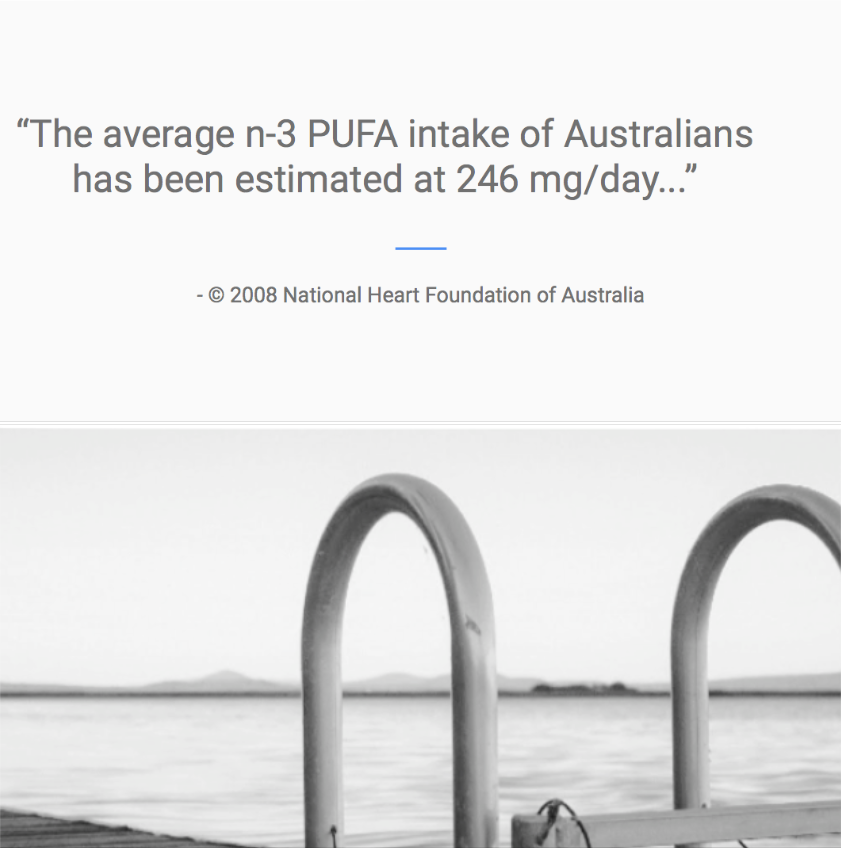
Currently, fish oil supplements are highly accessible and are being consumed by approximately 12% of the Australian population due to the widespread knowledge of possible health benefits (Australian Bureau of Statistics, 2011-2012). Despite this figure, the average Australian consumes merely 246 mg/day of DHA, EPA, and DPA combined (NHF, 2008).
Preconceived ideas and negative attitudes towards supplements play a major role in an individual's decision to supplement with fish oil and may cause a negative attitude towards taking fish oil. One of the past concerns with fish oil supplements was the concentration of mercury within the supplement. Although the logic may seem plausible, the fish oil supplements in Australia are strictly regulated and contain none, to negligible amounts of methylmercury (NHF, 2008).
"Measurement of Mercury Levels in Over-the-Counter Fish Oil Preparations"— Foran et al., 2003observed the concentration of mercury in 5 different over-the-counter fish oil supplements finding that they contained negligible amounts and suggest that fish oil supplements are actually healthier than fish because of it.
Fish oil is taken for many reasons. Commonly believed practical uses are reduction of swelling, physical longevity and anti-aging, desirable cosmetic effects on the hair and skin, improved recovery time from exercise-induced muscular damage, brain health, joint health, and many more. All of these claims and attributes are a product of studies that have a strong basis of scientific evidence.
In the face of these are studies which justify an opposing view and boldly indicate the opposite. Many factors affect physical longevity and it is hard to pin-point LC n-3 PUFAs direct influence. The physiological actions of LC n-3 PUFA in the body are numerous and influence a variety of conditions such as rheumatoid arthritis and diabetes mellitus.
Contrary to popular belief, consumption of fish oil supplements has been seen to significantly increase risk of prostate cancer. According to a study conducted by researchers at the Fred Hutchinson Cancer Research Center in the United States, elevated LC n-3 PUFA blood concentration levels increased risk of total prostate cancer and aggressive prostate cancer by approximately 43 and 71 percent respectively (Brasky et al., 2013). More research is necessary in order to determine whether the increased risk of prostate cancer outweighs the decreased risk of CVD.
In view of the fact that prostate cancer is only applicable to males, inconsistent evidence around the negative effects in female specific conditions such as breast and ovarian cancer fashions a consistent trend of positive outcomes for women and LC n-3 PUFA supplements (Kim et al., 2009, Hu et al., 2002).
Primary prevention within the NHF, 2008 Fish Oil Position Statement is described as the degree that which LC n-3 PUFA reduce the incidence of obtaining a CVD. A large-scale meta-analysis located within the Journal of the American College of Cardiology labelled
"Omega-3 Polyunsaturated Fatty Acids and Cardiovascular Disease"— Lavie et al., 2009provides retrospective insight. This article assessing efficacy found that fish oil supplementation was a significant protective factor against atherosclerosis, arrhythmias, coronary heart disease and heart failure. There were minimal side effects reported and these were only evident from excess intake of over 20g per day.
Now with the evidence aside, is it worth the money to consume fish oil capsules on a day-to-day basis in order to meet the minimum requirement?
One bottle of 400 capsules each containing 1000mg of DHA, DPA, and EHA cost around $15.00 AUD. One 1000mg capsule taken every two days is sufficient to fill the gap between what the average Australian consumes and the minimum requirement set by the National Heart Foundation in order to reduce the risk of chronic disease while still sitting well below the upper limit.
One capsule every two days would bring the average n-3 PUFA intake of Australians from 246mg/day to 746mg/day.
In order to achieve this every day for 60 years, it would cost $410.60 AUD!
References:
• Kromhout et al. (1985)
• Smith et al. (2015)
• National Heart Foundation Position Statement (2008)
• Foran et al. (2003) - Measurement of Mercury Levels in Over-the-Counter Fish Oil Preparations
• Brasky et al. (2013) - Fred Hutchinson Cancer Research Center
• Kim et al. (2009), Hu et al. (2002)
• Lavie et al. (2009) - Journal of the American College of Cardiology